
 NOW SERVING SAN DIEGO & SURROUNDING AREAS




Why It Matters
- Standard EV chargers use 120V and take up to 50 hours to charge fully. Level 2 chargers use a 240V battery and can charge an EV vehicle in 6 to 10 hours.
- Level 2 home EV charger installation is the preferred option for most San Diego homeowners because it offers faster charging and higher efficiency.
- Electrical panel capacity, charger type, and installation location all affect total installation requirements and cost.
If you’ve joined the ranks of environmentally conscious consumers, you may have purchased an EV vehicle charger for use outside of your home or office. Relying on a standard 120V charger is only experiencing a fraction of what home vehicle charging can offer. As an expert home services company, Comfort Bros can install a Level 2 EV charger for you. We’ve helped countless Southern California homeowners upgrade their charging capabilities.
What Is a Level 2 EV Charger?
A Level 2 home charger requires a 240-volt circuit and is available as either hardwired or plug-in. For drivers with long and daily commutes, a Level 2 charger will guarantee their vehicle stays fully charged, without having to make many stops.
Level 1 vs Level 2 Charging: What’s the Real Difference?
Level 1 charging uses your standard 120-volt household outlet, the same one you’d plug a phone charger into. It’s the slowest charging method, as fully recharging a typical EV with a 60 kWh battery from empty could take 40-50 hours. 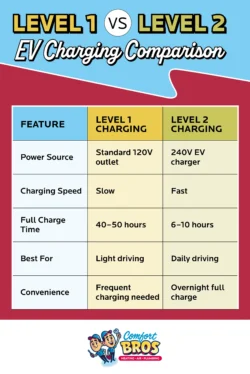
Level 2 EV charging can fully charge a 60 kWh dead battery in 6 to 10 hours. With Level 1 EV home charging, you’re constantly thinking about your battery Level and planning your driving around charging limitations. With Level 2, you can rely on overnight EV charging and start each day with a full tank.
How Fast Is a Level 2 Charger at Home?
Level 2 EV charging offers faster charging, between 12 kW and 19.2 kW, or approximately 10 to 20 miles of range per hour. The charging speed of your Level 2 EV charger depends on three key factors:
- The charger’s output: This typically ranges from 3.3 kW to 19.2 kW, with most residential installations falling in the 7.2 kW to 11.5 kW range.
- Your vehicle’s onboard charger: Onboard chargers convert AC energy from your Level 2 charger into DC energy. Many affordable EVs come with 6.6 kW or 7.2 kW onboard chargers, while premium EV models might support 11.5 kW or even 19.2 kW.
- Temperature effects: In periods of extreme cold, charging times are reduced. Though this is less common for San Diego, the difference for Level 2 chargers will be minimal.
- Why a Level 2 Charger Makes Sense for Daily Drivers
With a typical Level 1 charger, it takes 40 to 50 hours to fully charge a dead EV. This is fine if you only use your vehicle now and then or have access to a workplace charger, but it’s quite impractical for most daily drivers.
With Level 2 charging, you wake up to a fully charged vehicle every single day, regardless of how much you drove the previous day. The Level 2 model can also be paired with smart EV chargers to offer remote power monitoring and control to optimize energy use and cost.
This translates into cost savings as well. With a Level 2 charger, you never have to rely on fast city EV chargers that cost $0.40 to $0.60 cents per kWh, while home charging costs $0.20 to $0.30 per kWh.
Do I Need to Upgrade My Electrical Panel for a 240V Charger?
Many modern homes can support a Level 2 home EV charger without upgrading their electrical panel. Though some older properties with lower electrical panel capacity or limited space for new circuits will need upgrades.
Comfort Bros will evaluate your existing electrical infrastructure during the initial assessment. If electrical panel upgrades are necessary, we will provide clear explanations that help you make an informed decision.
Why Professional Installation Beats a DIY Approach
Installing a Level 2 EV charger requires electrical knowledge to work on a dedicated circuit, mount the charger, complete electrical connections, and verify its safe operation. Doing this without knowing the proper grounding system protocols and circuit protections can result in fires, electrocution, or equipment damage.
The state of California also requires specific permits and electrical code compliance for Level 2 EV charger installations. As a licensed electrician, Comfort Bros will handle everything from the initial panel assessment to the final inspection.
Simple Financing for Your Home EV Upgrade
Comfort Bros has partnered with Service Finance to offer flexible payment plans for EV charger upgrades. These customizable plans are designed for you to experience the benefits of Level 2 EV charging right away, while paying it off in a comfortable scenario for your budget.
Why Choose Comfort Bros for Your EV Charger Installation?
When you choose Comfort Bros for your Level 2 charger installation, you’re choosing a company dedicated to exceptional service, technical expertise, and customer satisfaction. Here’s what sets us apart from other electrical contractors in the San Diego area:
- Five-star reviews from satisfied customers.
- Special deals.
- Licensed and expert electricians.
- Same-day service available.
- Transparent costs before the work begins.
Serving Our Local Neighbors
We are proud to serve the following area codes in the San Diego area:
- Escondido (92025, 92026, 92027)
- Poway (92064)
- San Marcos (92069)
Ready to Supercharge Your Morning? Contact Comfort Bros Today
Start enjoying the convenience of waking up with a fully charged EV vehicle in San Diego. Comfort Bros makes the Level 2 installation process easy and transforms your EV lifestyle into one of reliability and optimal cost savings. Contact us today to supercharge your morning.
Frequently Asked Questions
What electrical requirements are needed for a Level 2 EV charger?
The electrical requirements for a Level 2 EV charger are a 240-volt circuit, the same circuit that powers your dryer or oven. Your home’s electrical panel also needs sufficient electrical capacity to be able to support the new addition.
Does a Level 2 charger require a 240V outlet?
A Level 2 charger does not require a 240V outlet, and it can be installed in two ways. The first is hardwired directly into your home’s electrical system without a 240V plug. The second is with a NEMA 14-50 plug that connects to your current 240V plug.
Is it better to hardwire a home EV charger or use a NEMA 14-50 plug?
The decision to hardwire or use a NEMA 14-50 plug comes down to a few factors. Hardwiring is cheaper and perfect if you are not planning on moving anytime soon. The NEMA 14-50 plug route offers more flexibility and can be plugged into any 240V outlet.
Are there tax credits or local rebates for Level 2 charger installation?
Yes, there are tax credits and local state rebates for level 2 charger installations. They can also be up to $7,500, making the cost of switching to a Level 2 charger worth it.
What is the best Level 2 charger for a Tesla vs. a non-Tesla EV?
The Tesla wall connector is the best Level 2 charger for Tesla vehicles. However, if you don’t own a Tesla, you will want a charger with a J1772 connector (the universal standard for EVs).